
Her side of the mirror: Re-imagining Manet in 2025

Updated: Nov 19, 2025
In 1882, Édouard Manet unveiled A Bar at the Folies Bergère, a painting that, even today, unsettles as much as it fascinates. Its enigmatic use of the mirror, its lone barmaid trapped between viewer and the distorted reflection, and its subtle commentary on gendered power dynamics made it one of the great modern works of art.
Just as Manet once reinterpreted Titian’s Venus to create his radical Olympia, I’ve decided to follow in his footsteps with a contemporary response of my own. My newest painting, Her Side of the Mirror, brings Manet’s vision into 2025 and confronts a truth we still wrestle with in the 150 years since A Bar at the Folies Bergère, I believe that far too little has changed for women.

Why Manet Matters Now
Manet was a painter who saw the world as it truly was—unpolished, contradictory, and unapologetically modern. His barmaid at the Folies-Bergère stands elegantly before us, but her reflection betrays a different reality. Manet used that visual tension to hint at something deeper: women in his era were often both the subject of desire and the object of commerce, admired and exploited in the same breath.
Today, despite our technological and social progress, the echoes of Manet’s world remain disturbingly familiar.
The modern stage is larger, digital, global, immediate, but the pressures and vulnerabilities faced by women persist. It is still a largely male dominated world, and consequently, overt and covert sexual pressures continue to be imposed on women. All women. For all our grandiose claims of equality, enlightenment and decency, the male ape is still driven by one overriding but unconscious desire. Sex. Some might challenge this statement and suggest that wealth is the prime mover, but even the wealthiest and most powerful still revel in 'grabbing them by the pussy'. How many famous names or billionaires can you name that haven't exploited women, or objectified and abused them through privilege or title?
In Manet's time, while photography was still in its infancy, pornography could only be accessed discreetly, perhaps commissioned by a gentlemen's wallet, a nudge and a wink. Today, it's available with one or two key strokes of a keyboard. How does this desensitise us? Have women been distilled into something less? A ‘non feeling’ convenience? Look at the barmaids expression in Manet's painting. It is charged with melancholy and futility.
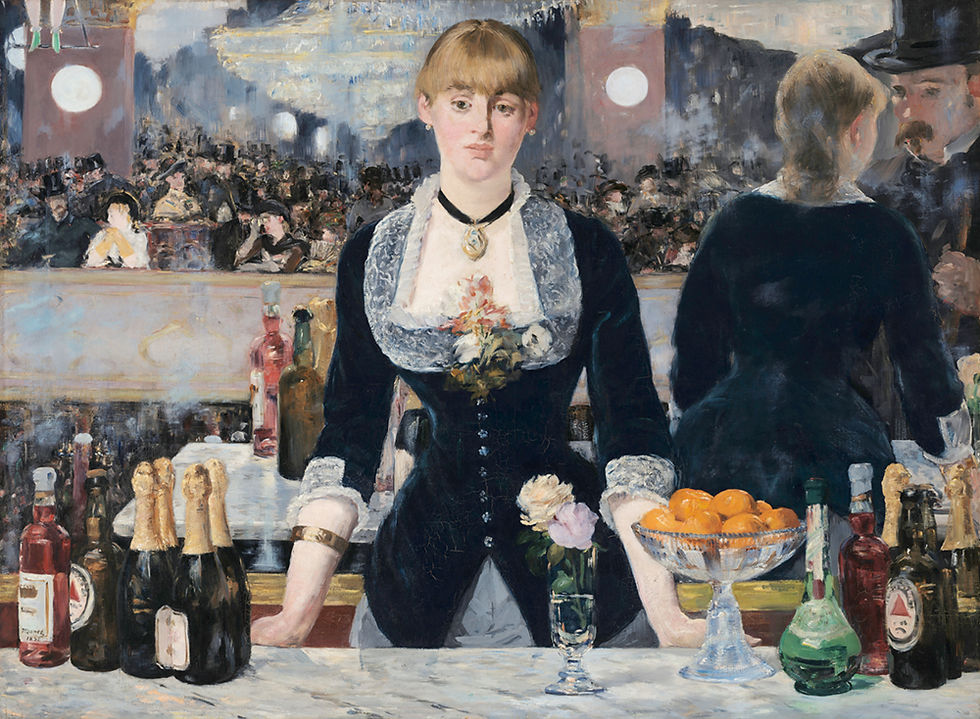
In his day, Manet recognised the subjugation and plight of working women, and he had the courage to confront male attitudes through his art. One might consider Manet a man ahead of his time, for when he met the Morisot sisters, Berthe and Edma, he remarked, "What a shame... they are not men," emphasising his awareness that their artistic merits would be stifled because of gender and an overarching patriarchal society.
Re-imagining the Scene for Our Time
Her Side of the Mirror is not a recreation of A Bar at the Folies Bergère. It is a continuation of the conversation that Manet began. I place a contemporary woman in the familiar stance: poised, composed, yet visibly carrying the weight of the gaze upon her. But the bar is no longer the bright spectacle of the Folies-Bergère. It is today’s world, smaller, more claustrophobic, a media-saturated culture, where smartphones and surveillance play a role in shaping our identity.
The cues throughout the painting reflect the ongoing sexual abuse, coercion, and mistreatment of women that permeates our supposedly modern liberated society. The mirror, once again, becomes the hinge between two realities: the public face and the hidden truth. On her side of the mirror, we see this dual existence.
A Conversation Across Centuries
My intention is not solely to honour Manet, though his influence is unmistakable. Instead, I want to question the viewer, and challenge myself, to confront the uncomfortable continuity between his time and ours. What has truly changed for women since 1882? What remains the same? What does it mean to be seen, judged, and consumed by a world that still fails to protect? To feel objectified and seen as a mere conquest, an opportunity or worse.
In re-imagining Manet’s masterpiece, I aim to bring attention to the experiences many women continue to endure, often silently, behind the reflective surface of everyday life. Art, at its best, helps us look again, more honestly, more critically, and I hope with more compassion.

Why I Painted Her Side of the Mirror
This piece is a statement born of frustration, but with empathy, and hope. From my two decades of working in the field of psychotherapy, a life that ran parallel to my world as an artist, I believe that I have been privileged to observe the shadow world that so many women live behind.
Frustration that the societal structures that failed women in 1882, still persist now in 2025. Empathy for the countless stories unheard, unspoken, or dismissed. Hope that revisiting a familiar image in a modern context can start or reignite a necessary dialogue.
Manet held up a mirror to his world. Her Side of the Mirror holds one up to ours.
But this work is not meant to be passively observed. Much like Manet’s original, it contains covert symbols, visual tensions, and quiet details woven intentionally into the composition, details that speak to the pressures, contradictions, and difficulties women face in contemporary life. I have great sympathy for bravery of the women that started the #metoo movement, and I vigorously applaud every single case brought against the worst of men. I wonder could it be re-labelled #allofus, because I cannot imagine a single woman alive for whom a line has not been crossed.

An Invitation to Look Deeper
I invite you all, collectors, curators, and fellow lovers of Impressionism, to read the painting as you would a poem, a witness account, or a fragment of social history. Look for the details that don’t immediately announce themselves. Look for what’s happening not just in the figure, but in the reflection and symbolism hidden within the gestural strokes of paint, the objects, the posture, the surrounding environment. Look for what feels slightly amiss.

Ask yourself: What is she seeing that we do not? What is she feeling, and what is the mirror refusing to reveal? Can I, as a heterosexual man, even profess to understand how it feels to be the subject of the male gaze or victim of worse?
Your interpretation is not just welcomed; it is part of the work’s meaning.

Comments